
Running is a fantastic way to improve cardiovascular fitness, strength and general wellbeing, but your muscles, tendons, bones and joints all need time to adapt to the demands of running.
Common running problems include shin pain, knee pain, Achilles irritation, calf problems and hip discomfort, and these can often develop when your training increases faster than your body is ready for.
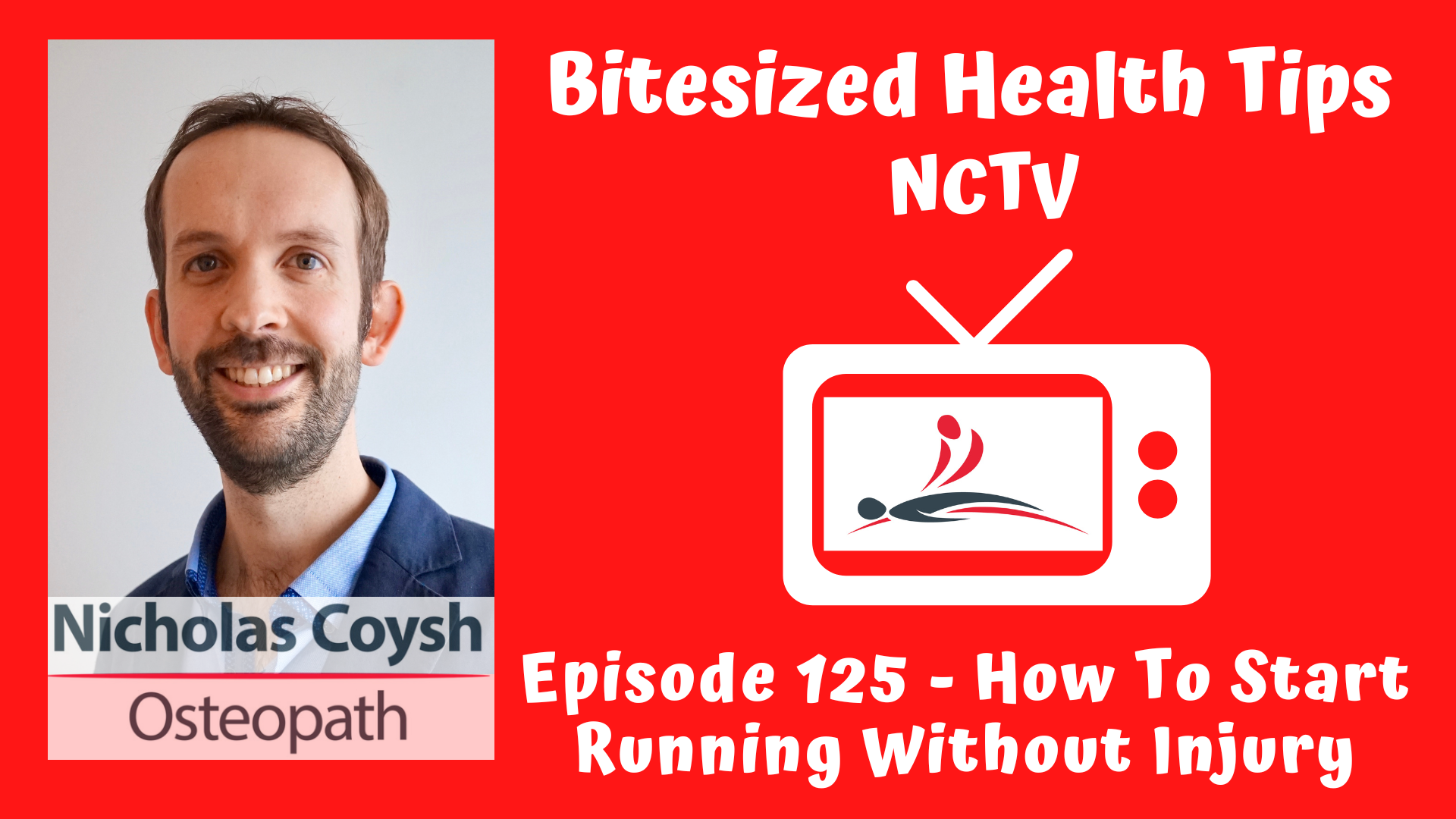
In NCTV Episode 125, Nick Coysh, osteopath at Nicholas Coysh Osteopathy & Wellbeing in Storrington, West Sussex, explains how to start running safely, why the run-walk approach can be so useful and why strength, recovery and listening to your body are all important.
NCTV Episode 125: What does this video cover?
🏃 Why running injuries happen
📈 How to increase running gradually
🚶 Why run-walk training can be so effective
💪 Why strength training matters for runners
😴 Why rest and recovery are part of training
👟 What your running shoes can, and can’t, do
🩹 Why you shouldn’t ignore running niggles
🩺 How osteopathy may help runners
Watch NCTV Episode 125: How To Start Running Without Injury
Why do running injuries happen?
One of the biggest reasons new runners get injured is simply doing more than their body is currently prepared for.
Think of it as a relationship between training load and capacity.
You might feel cardiovascularly capable of running for 30 minutes, but that doesn’t necessarily mean your calves, Achilles tendons, knees and other tissues are ready for the repeated impact.
This is particularly common when someone:
- Starts running from a relatively inactive baseline
- Returns after a long break
- Suddenly increases distance
- Increases the number of running days
- Runs much faster than usual
- Adds hills or other demanding sessions
The problem isn’t necessarily running.
It’s often progressing faster than your body can adapt.
What are the most common running injuries?
There are lots of different causes of running pain, but some problems appear particularly frequently.
These include:
Shin pain
Pain around the shin can develop when the lower leg is exposed to more loading than it is currently prepared to handle.
Knee pain
Knee discomfort can have many different causes and may be influenced by training load, strength, movement patterns and previous injury.
Achilles problems
The Achilles tendon has to deal with considerable repetitive loading during running. Increasing training suddenly can give it more work than it has adapted to.
Calf problems
Your calves work hard every time you run. Increasing distance, speed or hills can increase the demand significantly.
Hip pain
The muscles around the hips play an important role in running. Changes in training load or strength can sometimes contribute to discomfort.
The important point is that pain isn’t something you need to simply push through.
How quickly should I increase my running?
The answer depends on where you’re starting from.
There’s a commonly quoted 10% rule, suggesting that runners should increase their weekly distance or training load by no more than 10%.
However, it’s better viewed as a rough guideline rather than a scientific law.
For one person, a 10% increase might be perfectly manageable.
For someone else, it could still be too much.
Instead, think about gradual progression.
Increase your running in manageable steps and give your body enough time to adapt before adding more.
And remember that running isn’t just about mileage.
Increasing your:
- Distance
- Speed
- Frequency
- Hills
- Intensity
can all increase the overall training load.
You don’t necessarily want to increase several of these at the same time.
Is the run-walk method good for beginners?
Absolutely.
Running and walking intervals aren’t a sign that you’re failing at running.
They’re actually a very sensible way to introduce your body to the demands of running.
For example, you might start with:
Run → walk → run → walk
and gradually increase the amount of running over time.
The exact intervals aren’t important. What matters is finding a level that allows you to build your running without constantly feeling beaten up afterwards.
A run-walk approach can be particularly useful if you’re:
- Completely new to running
- Returning after a long break
- Recovering from an injury
- Carrying extra body weight
- Finding continuous running too demanding
You can always increase the running component as your fitness and capacity improve.
Should I run through pain?
This is one of the most important questions for new runners.
A little muscle soreness after doing something new isn’t necessarily a problem.
But persistent, worsening or significant pain shouldn’t simply be ignored.
Think of a niggle as your body’s warning system.
A small ache might be your body whispering:
“Perhaps ease off slightly.”
Ignore it for long enough and it may start shouting.
Pay particular attention if pain:
- Gets progressively worse while running
- Changes the way you run
- Persists between sessions
- Is present during normal daily activities
- Causes swelling
- Is associated with weakness or numbness
Changing your training early can sometimes prevent a relatively small problem from becoming a much longer interruption.
If you’re unsure about a persistent or significant running injury, get it assessed by an appropriately qualified healthcare professional.
Why is strength training important for runners?
Running isn’t just cardiovascular exercise.
Every stride places forces through your body, and your muscles help absorb and control those forces.
Strengthening areas such as the:
- 🦵 Calves
- 🍑 Glutes
- 🦿 Quadriceps
- 🧘 Core
- 🦵 Hamstrings
can help improve your ability to tolerate running.
You don’t necessarily need an elaborate gym programme either.
Squats, lunges, calf raises, step-ups and other appropriate strengthening exercises can all be useful.
The important thing is to choose exercises that are suitable for your current ability and progress them gradually too.
How important is rest when starting running?
Very.
One of the easiest mistakes for a new runner to make is thinking that more running automatically means faster progress.
It doesn’t.
Your body needs time to recover and adapt to training.
When you run, you’re creating a physical stimulus. The recovery period is when your body gets the opportunity to repair and adapt.
So rest days aren’t being lazy.
They’re part of the training programme.
If you’re running three times a week, for example, having recovery days between runs can give your body valuable time to adapt.
And if something is hurting, an additional recovery day may be much more useful than forcing yourself through another session.
Do running shoes prevent injuries?
Good running shoes can certainly be comfortable and appropriate for your running, but they’re not magic.
It’s easy to assume that buying a particular shoe will prevent injuries.
Unfortunately, your body didn’t get the memo.
Shoes are only one part of the picture.
Training load, recovery, strength, previous injuries, running surface, fitness and individual biomechanics can all influence how your body responds to running.
Choose footwear that is comfortable, appropriate for what you’re doing and suits your individual needs but don’t expect a pair of trainers to solve every running problem.
How can I start running safely?
If you’re new to running, a simple approach is often best.
Start with less than you think you can manage
Finishing a run feeling that you could have done a little more is generally preferable to destroying yourself on day one.
Use run-walk intervals
They allow you to build running capacity while controlling the overall workload.
Progress gradually
Give your body time to adapt before significantly increasing your training.
Don’t increase everything at once
Avoid simultaneously adding lots more distance, speed, hills and extra running days.
Strengthen your body
Include appropriate strength exercises alongside your running.
Take recovery days
Allow your muscles and other tissues time to adapt.
Listen to your body
Don’t ignore persistent or worsening pain in the hope that it will disappear.
How can osteopathy help runners?
If you’re starting running, returning after a break or dealing with a persistent niggle, osteopathy may be able to support you.
Depending on the individual problem, treatment may help with:
- Joint mobility
- Muscle tension
- Stiffness
- Movement patterns
- Managing minor niggles
- Recovery following injury
The aim isn’t necessarily to tell you to stop running.
Often, it’s about understanding what’s happening and adjusting your training so you can keep moving safely.
Osteopathy can also be combined with strengthening, rehabilitation, mobility work and appropriate running advice.
If you have significant or persistent symptoms, an assessment can help determine what’s causing the problem and whether osteopathy is appropriate.
What other support can help new runners?
You don’t have to figure everything out yourself.
Depending on your needs, useful options can include:
- Couch to 5K programmes for structured beginner progression
- Strength and conditioning to build physical capacity
- Running coaches for training structure and technique
- Physiotherapy for injury assessment and rehabilitation
- Mobility work where appropriate
- Rest and recovery strategies
The important thing is to build a body that’s ready for running rather than simply hoping it will cope.
Is running good for your health?
Yes.
Running can provide substantial cardiovascular and physical benefits, and for many people it’s also an enjoyable way to spend time outdoors and set themselves a goal.
But you don’t have to run fast or far for it to be worthwhile.
Your first goal might simply be completing your first continuous five minutes.
Then perhaps 10 minutes.
Then your first 5K.
The key is finding a level that’s appropriate for you and building from there.
Consistency beats intensity
It’s generally far better to run a manageable amount regularly than go all-in for two weeks and then spend the following six weeks recovering.
As with many things in life, slow and steady can get you surprisingly far.
What if I’m returning to running after an injury?
Returning to running after an injury deserves the same principle as starting from scratch:
Gradual progression.
Don’t assume that because you were previously capable of running 10K, a half marathon or even a marathon, your body is automatically ready to return to that level immediately.
Your previous fitness doesn’t necessarily equal your current capacity.
Start at an appropriate level, monitor how your body responds during and after running, and increase your training progressively.
If you’re unsure when or how to return after an injury, seek advice from an appropriately qualified professional.
Common questions about starting running
How often should a beginner run?
There isn’t one perfect schedule for everyone. Your starting point, fitness, previous injuries and recovery capacity all matter. Many beginners benefit from running with recovery days between sessions rather than running every day.
How far should I run when I first start?
Start at a distance or duration that feels manageable rather than choosing a target simply because someone else can do it. Run-walk intervals can make starting much easier.
Is it better to run or walk?
Both have benefits. For beginners, combining running and walking can be an excellent way to gradually build running capacity.
Should I run if my legs are sore?
Mild muscle soreness can be normal after unfamiliar exercise, but significant, persistent or worsening pain should not simply be pushed through. Consider reducing your training and seek advice if you’re concerned.
Can strength training help prevent running injuries?
Strength training can help your muscles and tissues tolerate physical loads. Exercises for areas such as the calves, glutes, hamstrings and quadriceps can be particularly useful for runners.
How long does it take to get used to running?
It varies considerably between individuals. Cardiovascular fitness may improve relatively quickly, but muscles, tendons, bones and other tissues also need time to adapt to the repeated loading of running.
Can osteopathy help with running injuries?
Depending on the problem, osteopathy may help address muscle tension, joint stiffness and movement restrictions and support recovery. Other healthcare professionals and rehabilitation approaches may also be appropriate depending on the injury.
Related NCTV Episodes
If you’re interested in running and preventing injuries, these NCTV episodes may also be useful:
- NCTV Episode 28 – Warming Up & Cooling Down
- NCTV Episode 54 – Parkrun For Health & Wellbeing
- NCTV Episode 63 – Shin Splints Advice
- NCTV Episode 90 – Foam Rollers
- NCTV Episode 111 – Winter Sports Injury Prevention
A personal running note from Nick
There’s a reason running is a subject particularly close to my heart.
When this episode was originally filmed in April 2026, I was preparing for my second TCS London Marathon, running for St Catherine’s Hospice.
At that point, the goal was to break four hours.
And thankfully, the training paid off.
I eventually finished the 2026 London Marathon in 3:53:50.
But one of the biggest lessons from marathon training wasn’t about running harder.
It was about consistency, recovery and listening to your body.
There were plenty of training runs where the sensible decision was to back off, rest or adjust the plan rather than blindly sticking to it.
Whether your goal is a first 5K, a parkrun, a half marathon or something much bigger, the same principle applies:
Build gradually, stay consistent and give your body time to adapt.
About NCTV
NCTV – Nicholas Coysh TV is Nick Coysh’s regular series of bitesize health and wellbeing videos covering common aches, pains, injuries, exercise, posture, mobility and general wellbeing.
Nick Coysh is an osteopath based in Storrington, West Sussex, helping people manage pain, improve mobility and understand how to look after their bodies through hands-on treatment and practical aftercare advice.
If you’re experiencing a running niggle that’s not settling, speak to Nick to discuss whether osteopathy may be appropriate for you.
This article is for general information and education and is not intended to replace individual medical advice, diagnosis or treatment. If you are concerned about your symptoms or have suffered a significant injury, please seek advice from an appropriately qualified healthcare professional.