
Racket sports such as tennis, padel, pickleball, badminton and squash are excellent ways to stay fit, improve coordination and enjoy some social time. However, the repeated sprinting, stopping, twisting, reaching and gripping involved can place considerable demands on the body, particularly if you suddenly increase how much you play.
The good news is that many racket sport injuries can be reduced by warming up properly, building your activity gradually, strengthening your body away from the court and paying attention to early warning signs.
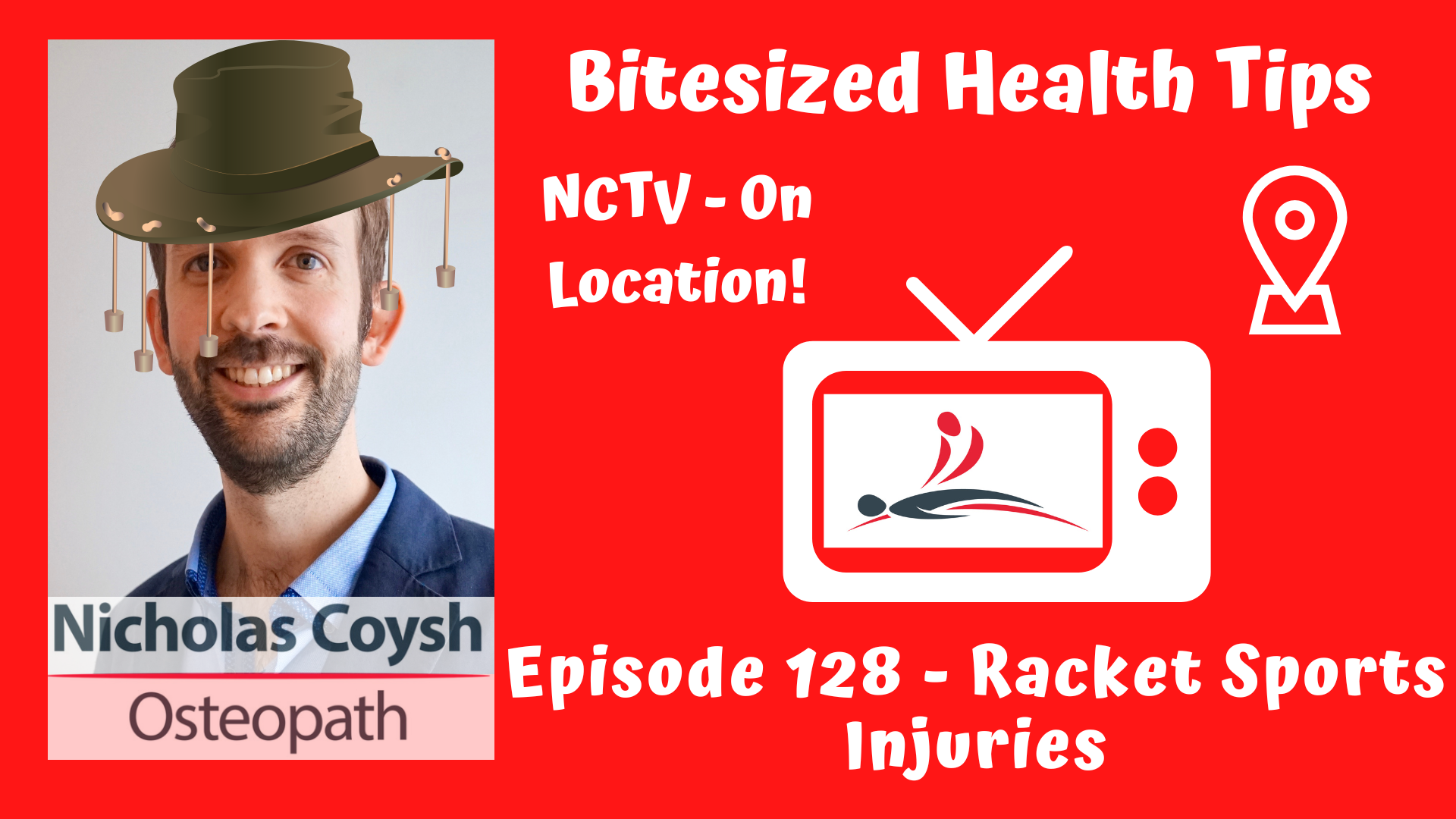
In NCTV Episode 128, Nick Coysh, osteopath at Nicholas Coysh Osteopathy & Wellbeing in Storrington, looks at some of the most common racket sports injuries, how you can help prevent them and what to do if an injury does occur.
NCTV Episode 128: What does this video cover?
🎾 The most common tennis and racket sport injuries
💪 Tennis elbow and why you don’t need to play tennis to get it
🏸 Shoulder, calf, Achilles, knee and lower back problems
🔥 How to warm up properly before playing
📈 Why building up gradually matters
⚖️ The importance of strength, balance and conditioning
🩺 How osteopathy and other forms of treatment can support recovery
What are the most common racket sports injuries?
Racket sports are fast-paced activities involving repeated acceleration, deceleration, rotation and changes of direction. During a typical tennis match, a player may change direction hundreds of times and cover several miles through a combination of running, sprinting and repositioning.
That means your muscles, tendons and joints can be working surprisingly hard.
The most common problems include tennis elbow, shoulder pain, calf and Achilles injuries, knee pain and lower back pain.
Let’s take a closer look at each one.
What is tennis elbow and how does it happen?
Despite its name, you don’t have to play tennis to develop tennis elbow.
Tennis elbow involves irritation of the tendons around the outside of the elbow. Repetitive gripping and wrist movements can contribute to the problem, which is why it can affect people involved in a wide range of activities.
Racket sports can increase the risk, particularly if:
- Your technique needs improvement
- Your racket grip is unsuitable
- You’ve suddenly increased how frequently you play
- You’re repeatedly gripping and hitting the ball without adequate conditioning
Typical symptoms can include pain around the outside of the elbow and reduced grip strength.
You might notice discomfort when lifting a shopping bag, kettle or even a mug of tea.
And, frankly, that’s when we know things have become serious.
How can I reduce my risk of tennis elbow?
Avoid suddenly going from very little racket sport to several long sessions a week. Give your body time to adapt.
It can also be worth reviewing your equipment and technique, particularly if symptoms repeatedly return.
If elbow pain is lingering rather than settling, getting it assessed early may help prevent a relatively small problem becoming a much bigger interruption to your sport.
Can playing racket sports cause shoulder pain?
Absolutely.
Serving, smashing and repeated overhead movements place significant demands on the shoulder.
Common problems can include:
- Rotator cuff irritation
- Shoulder impingement
- Muscle strains
- General shoulder stiffness
The important point is that shoulder pain doesn’t necessarily mean your shoulder is weak.
Sometimes the problem is simply a mismatch between what you’re asking the shoulder to do and what it is currently conditioned to cope with.
This is particularly relevant if you’ve taken up a new racket sport or dramatically increased your playing time.
Good shoulder mobility, appropriate strength and gradually increasing the workload can all help.
Why do racket sports cause calf and Achilles injuries?
Think about what happens during a typical game.
You accelerate towards the ball, stop, change direction, push off again and repeat the process, sometimes dozens or hundreds of times.
Your calves and Achilles tendons have to absorb and produce a considerable amount of force.
This can become a particular problem for the classic “weekend Wimbledon warrior”.
You’ve barely played for months, the sun comes out, Wimbledon inspires you and suddenly you’re spending three hours on court.
Your enthusiasm may be fully match-fit.
Your Achilles tendon may not be.
A gradual return to sport is therefore important, particularly after a long period away.
Why does my knee hurt when I play tennis, padel or pickleball?
Racket sports involve frequent pivoting, twisting, stopping and changing direction.
The knees have to cope with these repeated movements and loads.
Depending on the individual, problems can include:
- Tendon irritation
- Ligament strains
- General knee pain
- Pain related to existing knee problems
Strength, balance and conditioning are particularly important here.
If your legs are not accustomed to repeated changes of direction, suddenly increasing your court time can put more stress on the tissues around the knee.
Can racket sports cause lower back pain?
Yes, particularly sports involving repeated rotation and reaching.
Serving, returning shots and twisting to reach the ball can all place demands on the lower back.
Problems may include muscle strains, joint irritation or aggravation of an existing back problem.
This doesn’t mean that racket sports are bad for your back. Far from it.
The issue is often how much load your back is being asked to handle compared with what it is currently prepared for.
Good general conditioning, appropriate strength and gradually increasing your playing time can all help.
How can I prevent racket sports injuries?
Prevention doesn’t have to mean spending hours in the gym.
A few simple habits can make a significant difference.
Do I really need to warm up before playing?
Yes.
I know. Nobody particularly enjoys warming up when there’s a court waiting for them.
But five minutes of preparation is considerably preferable to five weeks of rehabilitation.
Before playing, consider:
- Gentle jogging or brisk movement
- Dynamic stretches
- Shoulder mobility exercises
- Gentle practice swings
- Gradually increasing the intensity before playing at full speed
The aim is to prepare your body for the movements you’re about to ask it to perform.
How quickly should I increase my racket sport activity?
Gradually.
One of the easiest ways to get injured is to increase your workload dramatically because you’re feeling enthusiastic.
If you’ve not played for several months, don’t immediately attempt a three-hour session.
Start with a manageable amount of activity and allow your muscles, tendons and joints time to adapt.
This is particularly important when taking up a new sport such as padel or pickleball, where you may be learning unfamiliar movements while simultaneously trying to keep up with the game.
What exercises can help prevent racket sport injuries?
Strength and conditioning away from the court can help prepare your body for the demands of racket sports.
Useful areas to work on include:
Leg strength – to help with acceleration, deceleration and changes of direction.
Core strength – to support the body during rotation and dynamic movement.
Shoulder strength – particularly important for serving and overhead shots.
Balance – useful for stability and control when moving quickly around the court.
You don’t necessarily need a complicated programme. The important thing is that your training complements the activity you’re doing.
Should I play through racket sport pain?
Not every ache means you need to stop playing completely.
Some muscle soreness after unfamiliar exercise is perfectly normal.
However, pain that is worsening, persistent, repeatedly returning or affecting your performance is worth paying attention to.
Don’t wait until your body has to issue a formal written complaint.
Addressing a developing problem early may allow you to modify your activity rather than having to stop altogether.
When should I seek help for a racket sports injury?
Consider getting professional advice if:
- Pain isn’t settling with sensible modification of activity
- Symptoms are getting worse
- The problem keeps returning every time you play
- Pain is affecting your technique or performance
- You’re losing strength or movement
- You’re unsure whether you should continue exercising
For a significant injury, particularly if there is substantial swelling, deformity, inability to bear weight or severe pain, seek appropriate medical assessment.
How can osteopathy help with racket sport injuries?
Osteopathy can be useful when you’re dealing with musculoskeletal problems associated with racket sports.
An osteopath may assess how the different parts of your body are moving and identify factors that could be contributing to an area becoming overloaded.
Treatment may include approaches aimed at:
- Improving joint mobility
- Reducing muscle tension
- Supporting recovery from strains and overuse injuries
- Assessing movement patterns
- Helping you return to your normal activities safely
Importantly, this isn’t necessarily about simply treating the painful area.
If your elbow hurts, for example, it can be useful to consider why that area has become overloaded in the first place — including factors such as technique, equipment, strength, mobility and changes in activity levels.
What other treatments can help racket sports injuries?
Osteopathy is just one option.
Depending on the injury and individual circumstances, other useful approaches can include:
- Physiotherapy for assessment, rehabilitation and exercise-based treatment
- Strength and conditioning to improve physical capacity
- Sports massage where appropriate for muscle tension and recovery
- Coaching to assess and improve technique
- Rehabilitation exercises to build strength and confidence before returning to full activity
Often, the best approach is not about choosing one treatment but combining the right strategies for the individual.
Are racket sports good for your health?
Despite the potential for injury, absolutely.
Racket sports provide a combination of cardiovascular exercise, strength, coordination, balance and social interaction.
Research has also associated recreational racket sports with significant longevity benefits.
So the answer isn’t to avoid tennis, padel, pickleball, badminton or squash because you might get injured.
It’s to play intelligently.
Prepare your body, increase your activity gradually, build strength away from the court and listen when your body starts giving you useful information.
Common questions about racket sport injuries
Can you get tennis elbow without playing tennis?
Yes. Tennis elbow can result from repetitive gripping and wrist movements, so people who have never played tennis can develop it.
What is the most common injury in tennis?
There isn’t one single injury that affects everyone. Tennis players can experience problems involving the elbow, shoulder, calf, Achilles tendon, knee and lower back, among other areas.
Can padel cause injuries?
Yes. Like other racket sports, padel involves repeated acceleration, stopping, twisting and reaching. Gradually building up your playing time and developing appropriate strength and conditioning can help reduce the risk.
Is pickleball hard on your knees?
Pickleball involves repeated changes of direction, stopping and pivoting, which can place demands on the knees. Good leg strength, balance, suitable footwear and gradual progression can all help.
Should I warm up before playing tennis?
Yes. A short warm-up involving general movement, dynamic mobility and sport-specific practice can help prepare your body for the activity ahead.
How long should I rest after a racket sport injury?
That depends on the injury and its severity. Complete rest isn’t always necessary or helpful for every musculoskeletal problem. In many cases, modifying activity and gradually returning to movement is more appropriate, but significant or persistent injuries should be professionally assessed.
Related NCTV Episodes
If you enjoyed this episode, you may also find these NCTV videos useful:
🎾 Episode 64 – Tennis Elbow Treatment
🏃 Episode 28 – Warming Up & Cooling Down
🦶 Episode 42 – Ankle Sprains
💪 Episode 57 – Back Pain Help
These related videos can help you explore some of the individual problems and prevention strategies discussed in this episode.
About NCTV
NCTV – Nicholas Coysh TV is Nick Coysh’s regular series of bitesize health and wellbeing videos, covering common aches, pains, injuries, exercise, movement and general wellbeing.
Nick Coysh is an osteopath based in Storrington, West Sussex, helping people understand their pain, improve their movement and stay active through tailored treatment and practical aftercare advice.
If you’re struggling with a persistent racket sport injury or another musculoskeletal problem, speak to Nick to discuss whether osteopathic treatment may be appropriate for you.
This article is intended for general information and education and should not be used as a substitute for individual medical assessment or professional healthcare advice.