
A summer holiday should leave you with great memories, a tan and perhaps far too many photographs of the same sunset, not a stiff back, sore feet or a shoulder that objects every time you reach for your suitcase.
From long journeys and unfamiliar beds to beach walks, flip-flops, water sports and spontaneous games of football, holidays can put demands on your body that you’re simply not used to.
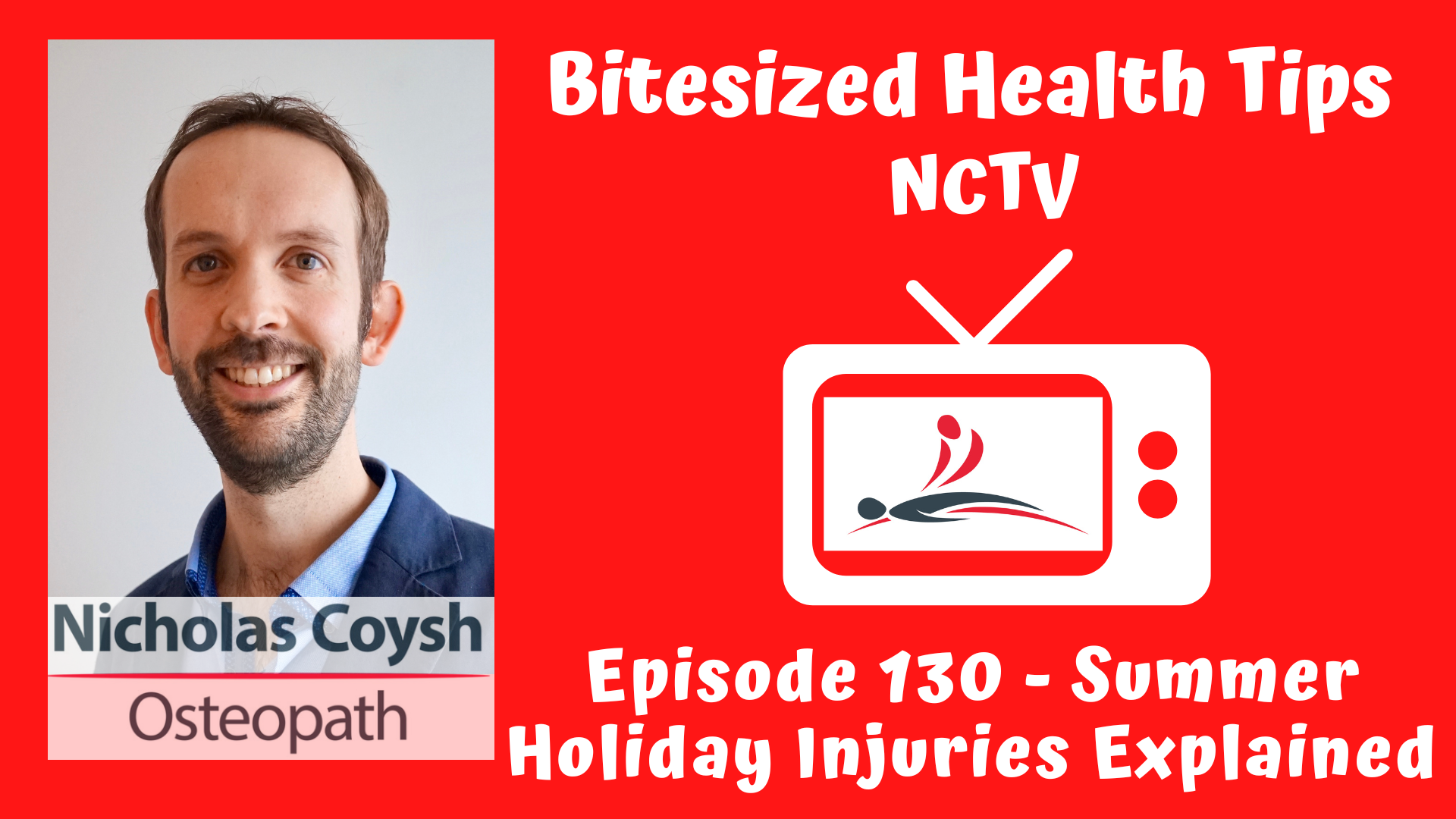
In NCTV Episode 130, Nick Coysh, osteopath at Nicholas Coysh Osteopathy & Wellbeing in Storrington, West Sussex, explains some of the most common summer holiday injuries, aches and pains, why they happen and, importantly, what you can do to reduce your risk of bringing an unwanted souvenir home with you.
NCTV Episode 130: What does this video cover?
🏖️ Why beach walking can cause foot, calf and knee pain
🩴 Why flip-flops aren’t ideal for long walks
🧳 How travel, luggage and prolonged sitting can cause aches
⚽ Why spontaneous holiday sports can lead to injury
🏄 How paddleboarding can affect your shoulders and back
☀️ Why sun loungers can contribute to stiffness
💪 How to prevent holiday injuries
🩺 What to do if you come home with a lingering injury
Watch NCTV Episode 130: Summer Holiday Injuries Explained
Why do I get aches and pains after a holiday?
Sometimes the holiday injury doesn’t actually happen on holiday.
It starts on the journey.
Long car journeys, flights, carrying luggage through airports, lifting suitcases and sleeping in an unfamiliar bed can all contribute to stiffness and discomfort.
If you’ve spent several hours sitting in one position, your back, neck and hips may feel stiff when you finally arrive.
Then, once you’re there, you might suddenly become much more active than usual.
Perhaps you’re walking several miles around a resort, exploring somewhere new, playing beach sports, swimming, paddleboarding or simply spending much more time on your feet.
Your body may not have had time to adapt to the sudden increase in activity.
This is one of the biggest themes when it comes to holiday injuries:
Don’t go from zero to holiday hero overnight.
Can long journeys cause back and neck pain?
Yes. Prolonged sitting can leave your back, hips and neck feeling stiff and uncomfortable.
The problem isn’t necessarily sitting itself. It’s staying in one position for too long.
If you’re driving or travelling for several hours, try to build regular movement breaks into the journey.
Get out of the car, walk around and give your body a chance to move.
If you’re flying, take opportunities to stand up and move around when it is safe and appropriate to do so.
And remember that the journey home counts too. You may have spent two weeks being wonderfully active, only to spend eight hours sitting in a car on the way back.
Your body may have something to say about that.
A simple holiday travel tip
Think little and often.
You don’t need an elaborate stretching routine every hour. Simply changing position, walking around and moving your joints regularly can help prevent you becoming excessively stiff.
Why does walking on sand make my feet hurt?
Walking barefoot on a beach feels wonderfully relaxing, but your body has to work harder than you might realise.
Sand is an uneven and constantly shifting surface. Your feet, ankles and calves have to make continual adjustments to keep you balanced.
If you’re accustomed to walking on pavements, roads or relatively firm ground, suddenly walking several miles along soft sand can place additional demands on muscles and joints.
You may notice aching in your:
- Feet
- Ankles
- Calves
- Knees
- Hips
This doesn’t mean you should avoid beach walks.
Instead, build up gradually.
A short stroll along the sand is very different from suddenly deciding you’re going to walk the entire coastline.
And if you’ve recently had a problem with your feet, ankles or lower limbs, be particularly sensible about increasing your walking distance.
Can flip-flops cause foot pain?
Flip-flops are a holiday staple, but they’re not necessarily the best footwear for walking long distances.
Because a flip-flop doesn’t stay securely attached to your foot, you may unconsciously grip it with your toes to keep it in place.
That can alter your walking pattern and potentially place additional strain on the feet and calves.
So, by all means wear your flip-flops around the pool.
Just perhaps don’t attempt the Marathon des Sables in them.
For longer walks, excursions or sightseeing days, supportive and comfortable footwear is usually a better option.
Why do holiday sports cause injuries?
One of the easiest ways to get injured on holiday is to suddenly become an athlete.
Someone produces a football.
Someone else finds a frisbee.
Before you know it, you’re playing beach volleyball despite not having played since school.
The problem is that your enthusiasm may be considerably fitter than your muscles.
Sudden sprinting, jumping, twisting and changing direction can put significant demands on your body.
This can contribute to:
- Muscle strains
- Ankle injuries
- Knee pain
- Back pain
- Shoulder problems
The solution isn’t to sit on the sidelines.
Have a gentle warm-up, start gradually and give your body time to adjust.
And perhaps don’t attempt that spectacular overhead bicycle kick immediately after lunch.
Your dignity may not recover.
Can paddleboarding cause back and shoulder pain?
Paddleboarding is fantastic exercise and a brilliant way to enjoy being outdoors.
However, it can be surprisingly demanding on your shoulders, back and core.
You’re repeatedly paddling, often on alternating sides, rotating through your trunk and making constant small adjustments to maintain your balance.
If you’re new to paddleboarding, it’s perfectly possible for your muscles to complain the following day.
Start gradually and don’t assume that because an activity looks relaxing, it isn’t physically demanding.
And if you fall in?
Well, that’s generally considered part of the experience.
Unless everyone else is watching, in which case it’s obviously an advanced manoeuvre.
Can sun loungers cause back and neck stiffness?
Lying down feels like rest, and it is.
But several hours in one position isn’t necessarily what your body needs.
If you’re reading with your head propped forward, looking down at your phone or simply lying in an awkward position for hours, your neck, lower back and hips may become stiff.
The answer isn’t to abandon the sun lounger altogether.
Instead:
Change position regularly.
Get up.
Walk around.
Move your neck, back and hips.
Your holiday doesn’t need to become a competition to see who can remain horizontal for the longest.
Can carrying holiday luggage cause back pain?
Holidays involve an extraordinary amount of carrying.
Suitcases.
Beach bags.
Parasols.
Cool boxes.
Inflatables.
Children.
And somehow, despite packing everything you own, you still need one more bag.
Try to distribute weight evenly and use both hands where possible.
Avoid repeatedly carrying a heavy bag on one side of your body.
When lifting something awkward or heavy, try to bend through your hips and knees rather than twisting your back while lifting.
And don’t underestimate the cumulative effect of carrying luggage around airports, hotels and accommodation.
Sometimes it’s not one enormous lift that causes the problem, it’s repeated awkward lifting when you’re tired.
What should I do if I injure myself on holiday?
First of all, don’t panic.
For a minor strain or knock, reduce or modify the activity that’s aggravating it and keep gently moving within comfortable limits.
Complete immobilisation isn’t always necessary and, unless you’ve been advised otherwise, gentle movement can often be preferable to doing absolutely nothing.
However, some injuries need proper assessment.
Seek appropriate medical attention if you experience symptoms such as:
- Significant swelling
- Severe or worsening pain
- Inability to put weight through a limb
- Obvious deformity
- Numbness
- Significant weakness
- Other worrying or unusual symptoms
And if an injury simply isn’t settling after your holiday, don’t keep hoping it will magically disappear.
Getting it assessed can help establish what’s going on and what you should do next.
How can osteopathy help with holiday aches and injuries?
Osteopathy may be useful for a range of muscle and joint problems that occur during or after a holiday.
Depending on the individual problem, treatment may help with:
- Back and neck stiffness
- Muscle tension
- Restricted joint movement
- Post-travel aches
- Sports-related strains
- Hip discomfort
- Shoulder discomfort
The aim is to help you move comfortably and support your recovery so you can return to your normal activities.
But hands-on treatment is only one part of recovery.
Exercise, strengthening, mobility work, rehabilitation and sensible progression can all play an important role too.
If you’ve returned from holiday with an ache or niggle that isn’t settling, an osteopath can assess whether osteopathic care is appropriate or whether another healthcare professional would be more suitable.
How can I prevent holiday injuries?
You don’t need to spend your holiday worrying about getting injured.
A few straightforward habits can make a big difference.
🚗 Take movement breaks
If you’re travelling for several hours, stop regularly on car journeys and move around.
🏖️ Build up beach walking
Don’t go from barely walking on sand to completing a five-mile beach hike on your first morning.
🩴 Choose appropriate footwear
Flip-flops have their place, but supportive footwear is preferable for longer walks.
🏃 Warm up before sport
Even if it’s only a friendly game on the beach, prepare your body before suddenly sprinting, jumping and twisting.
🏄 Pace water sports
If you’re new to paddleboarding or another activity, start gently and allow your body time to adapt.
🪑 Keep moving
Even on a relaxing holiday, change position regularly.
🧳 Lift sensibly
Distribute loads where possible and avoid twisting while lifting.
Most importantly, listen to your body.
A little muscle soreness after trying something new isn’t necessarily a problem. Increasing or persistent pain is a different matter.
How much coastline does the UK have?
Here’s a final fact for you.
The UK has approximately 7,700 miles of coastline.
That’s a lot of beaches, cliffs, promenades and coastal paths to explore, and plenty of opportunities to get ourselves into trouble!
Fortunately, you don’t need to avoid them.
The key is to prepare your body, build activity gradually and use a little common sense.
Whether you’re exploring the coast of Cornwall, walking along a beach in Sussex or enjoying a holiday abroad, your body will generally cope better when you give it time to adapt.
Common questions about summer holiday injuries
Why does my back hurt after a holiday?
Long journeys, prolonged sitting, lifting luggage, unfamiliar beds and changes in activity can all contribute to back stiffness or pain.
Why do my feet hurt after walking on the beach?
Walking on sand requires your feet, ankles and calves to constantly adapt to an uneven surface. If you’re not accustomed to it, suddenly walking long distances can lead to soreness.
Are flip-flops bad for your feet?
Not necessarily. They’re perfectly useful for short periods, but their lack of support and tendency to make you grip with your toes can make them less suitable for prolonged walking.
Why do I ache after playing sport on holiday?
Holiday sports often involve movements you’re not accustomed to, such as sprinting, jumping and twisting. Doing too much too soon can increase your risk of muscle and joint problems.
Can paddleboarding cause back pain?
It can contribute to muscle soreness or discomfort, particularly if you’re new to the activity. Paddling involves repeated shoulder movements, trunk rotation and balance adjustments.
Can sitting on a sun lounger cause back pain?
Remaining in one position for a prolonged period can contribute to stiffness in the neck, back and hips, particularly if you’re looking down at a phone or reading in an awkward posture.
What should I do about an injury after returning from holiday?
For a minor problem, reduce aggravating activity and keep gently moving within comfortable limits. If symptoms are severe, worsening, associated with worrying signs, or simply aren’t settling, seek appropriate professional advice.
Related NCTV Episodes
If you’ve enjoyed this episode, you may also find these useful:
- NCTV Episode 117 – Travel Twinges
- NCTV Episode 81 – Swimming Injuries
- NCTV Episode 93 – Holiday Wellbeing
- NCTV Episode 127 – Why Your Feet Hurt in Summer
About NCTV
NCTV – Nicholas Coysh TV is Nick Coysh’s regular series of bitesize health and wellbeing videos covering common aches, pains, injuries, exercise, posture, mobility and general wellbeing.
Nick Coysh is an osteopath based in Storrington, West Sussex, helping people manage pain, improve mobility and understand how to look after their bodies through hands-on treatment and practical aftercare advice.
If you’ve returned from holiday with an ache or niggle that isn’t settling, speak to Nick to discuss whether osteopathy may be appropriate for you.
This article is for general information and education and is not intended to replace individual medical advice, diagnosis or treatment. If you are concerned about your symptoms or have suffered a significant injury, please seek advice from an appropriately qualified healthcare professional.